What you’ll make
A three-shot plan and a prompt you can adapt for your next AI video.
What you’ll need
- One subject or product you want to show.
- A place to write a shot list; rough sketches are fine.
- Reference photos if the subject needs to look a particular way.
Okay, the clip looks cool. But does it do anything for the video?
That is the question to answer before another round of generations. A dramatic camera move will not rescue a shot that leaves out the one thing you wanted to show.
Write three lines first: what the viewer sees at the start, what changes, and what they see at the end. You can do this before opening Runway or any other video tool. No credits required for a notebook.
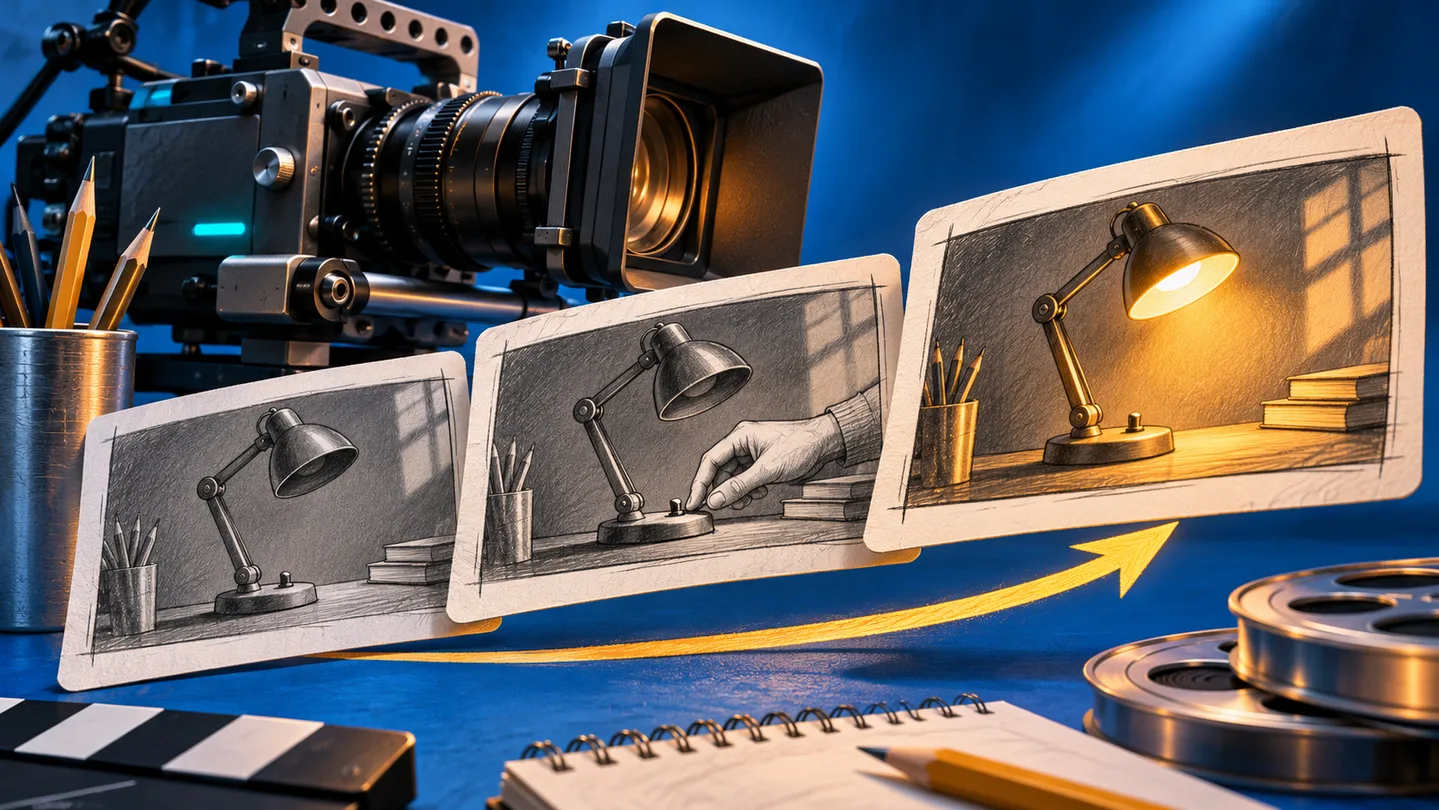
We’ll use an imaginary desk-lamp video as a planning exercise. The goal is simple: show a dark corner of a desk becoming useful when the light comes on. The cover is an illustration of that idea; this guide does not present generated footage or a product test.
Give the video one job
Finish this sentence:
By the end of this video, the viewer should understand ______.
For the lamp: “This light makes the notebook easier to see.”
That is something you can show. “Make an amazing ad for this lamp” still leaves the whole job undecided.
Pick the visible change first. If you are showing a real product, use its actual appearance and verified features. For a demonstration people could treat as proof of how it works, use real footage.
Write the three shots
Here is our starter storyboard:
- Before: The lamp is off. An open notebook sits in a dim corner of the desk. The camera stays still.
- Action: A hand switches the lamp on. Keep the shot close enough that the action is obvious.
- After: The same notebook is lit. Hold the shot long enough to register the change.
There. A beginning, something happening, and a reason it mattered.
Keep each shot separate. If the middle clip is wrong, you can replace that part without rebuilding the whole sequence.
Look at the difficult shot before generating. The hand needs to touch a specific switch. If that contact has to be exact, consider filming it yourself. The finished video can combine real footage with generated material when that serves the project.
Turn one shot into a brief
Start with the subject, action, and camera position. Add the setting and lighting that the shot needs.
Here is a starting brief for the opening:
A black desk lamp sits beside an open notebook on a walnut desk. The lamp is off. Soft evening light comes from the left. Medium close-up at desk height. The camera and objects stay still.
Treat this as a planning brief to adapt to your chosen model and input mode. If you supply a reference image, make sure the written direction agrees with it. A prompt describing a black lamp will not help you preserve a white lamp in the reference.
For the next shot, carry forward the details that matter: the lamp, notebook, desk, and lighting direction. Change the action you need. If you change the whole scene, it gets harder to tell why the result changed.
Check the sequence before the polish
Put rough sketches, stills, or test clips in order. Watch them without music or narration.
Ask:
- Can someone tell what changed?
- Does it look like the same desk and lamp throughout?
- Does the action explain the final shot?
- Have you accidentally suggested a product feature that is not real?
If the point is unclear, fix the sequence. Save the fancy camera move for a version that already makes sense.
Make the next attempt answer a question
Before you rerun a shot, write down what you want to change. “Keep the lamp the same shape” is a useful note. “Try again and hope” gives you very little to compare.
Save the prompt, reference image, model, input mode, and settings with each attempt. Change one major thing at a time where possible. You are building a process you can come back to, not just a folder full of almost-right clips.
Need help tightening the brief? Work through our four-part ChatGPT prompt guide. When the sequence is ready, turn the process into a written guide while the details are still fresh.
Try this prompt
Help me plan a three-shot video before I generate any clips.

Subject: [what the viewer should notice]
Audience: [who the video is for]
Point: [the one thing the viewer should understand]
Assets I have: [photos, footage, or reference images]
Constraints: [format, setting, time, and details that must stay accurate]

Give me an opening, an action, and a payoff.
For each shot, describe the subject, one main action, camera position,
and the details that must match the other shots.
Keep the sequence understandable without narration.
Flag assumptions and shots that would be easier to film for real.
Do not invent product features or promise a particular result.